
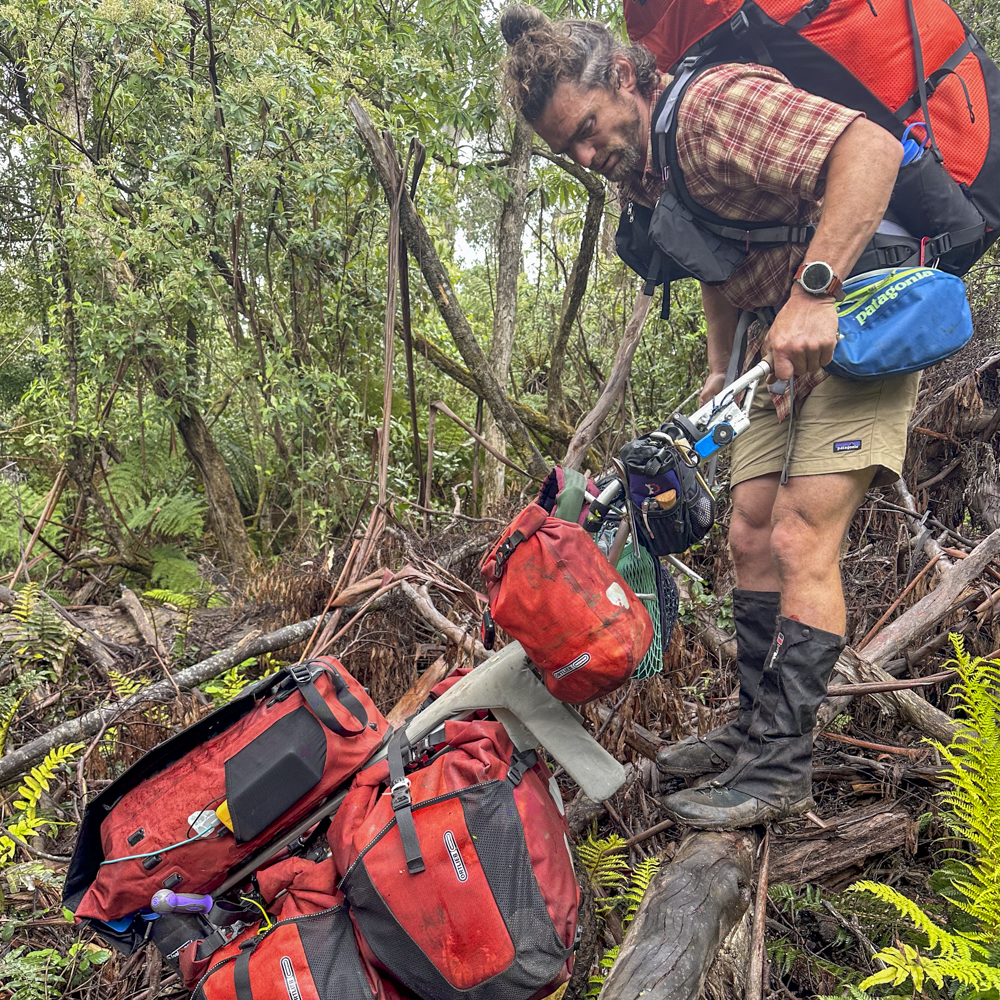
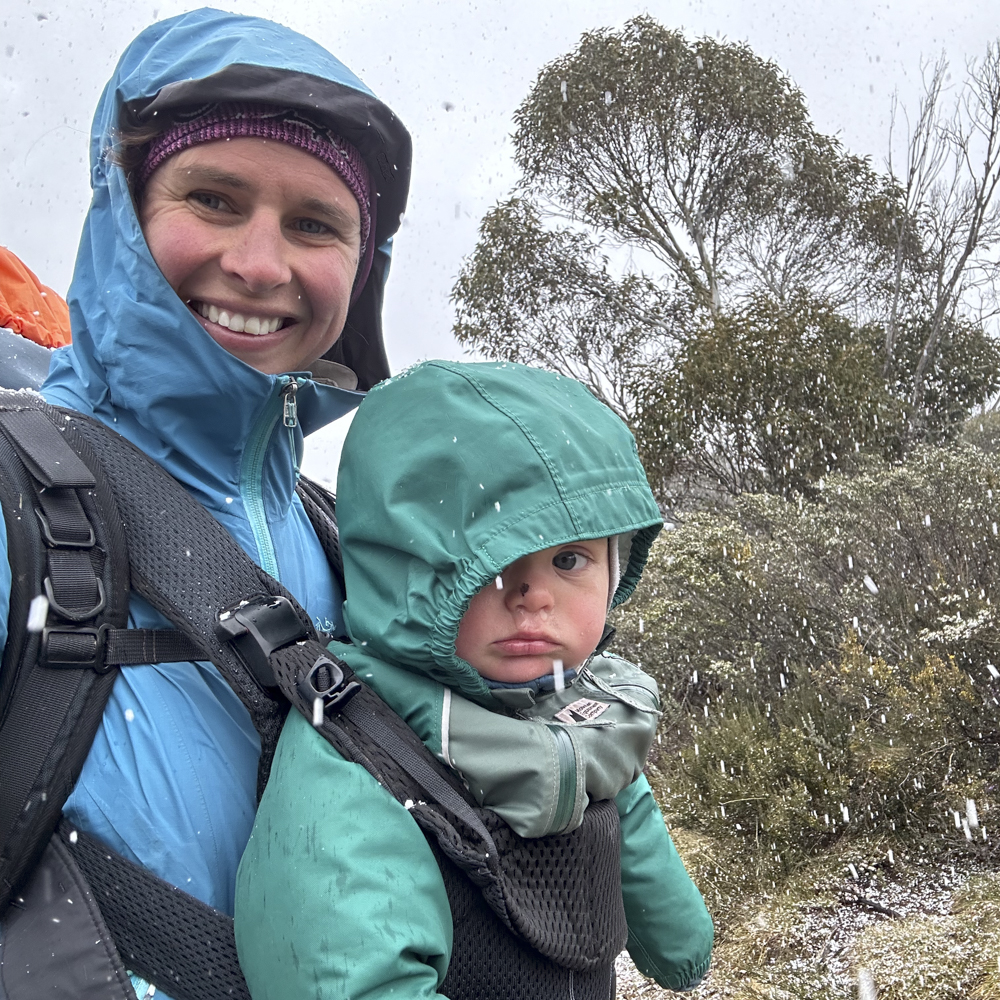
We worked together like a dog sled team to get ourselves, our two kids—Kiah (1) and Indigo (4)—and all our gear up a steep, slippery mountainside. Every few meters, a massive fallen tree would bar the trail. While Indigo and I (carrying Kiah) could clamber over the logs, Pat had to negotiate a one-wheeled cart and the bulk of our gear over every single log. The rain was heavy and the leeches were plentiful.
Surprisingly, our spirits were still high. It was only Day 4 of our 650km Australian Alps Walking Track (AAWT) expedition. Honestly, the kids were loving it. Even though it was undeniably grueling, so were we. This was the remote Victorian Alpine experience we had dreamed about and planned for months.
Then, we did the math.
At the end of that day, we had covered just 4km in eight demanding hours. At this rate, it wouldn’t take us six weeks to complete the 650km trail; it would take us four months.
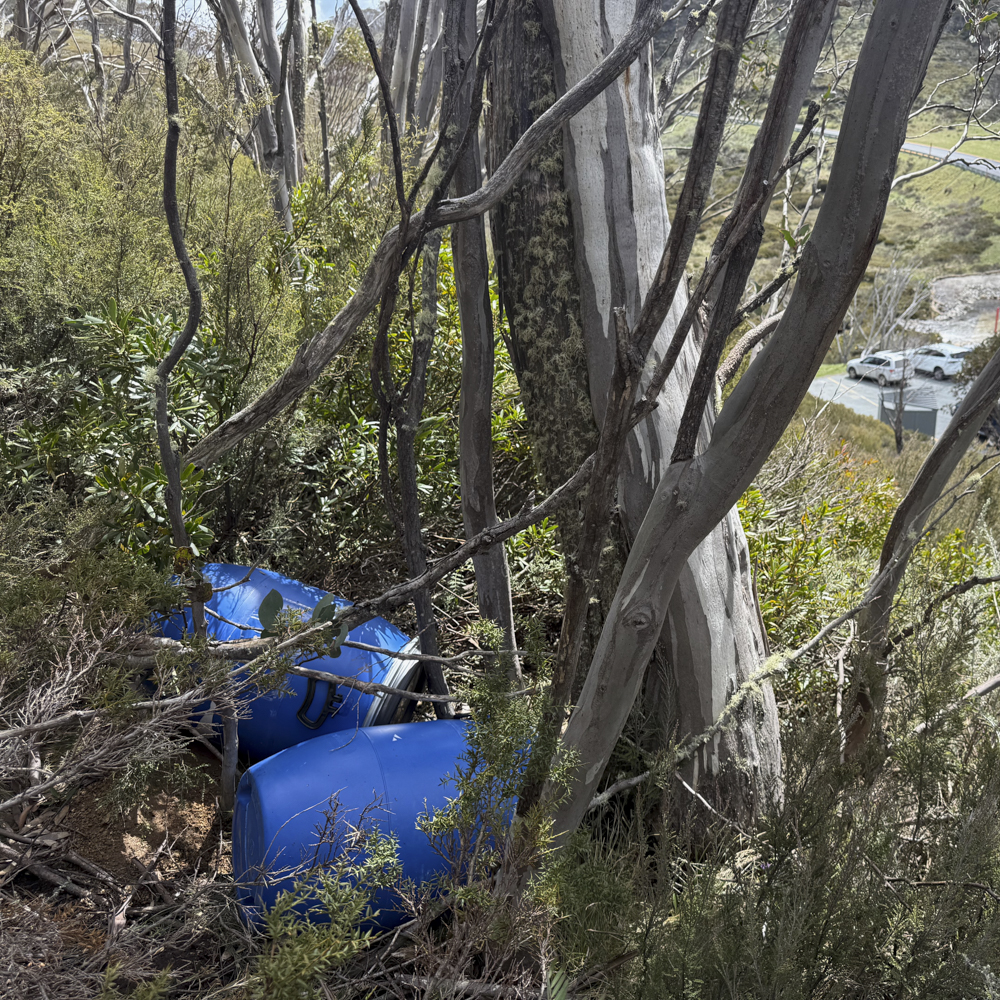
A few weeks before we hit the trail, Pat and Indigo had completed five major food drops along the route. That in itself was a massive logistical feat—planning meals for two adults and two kiddos, broken down into two barrels per drop. Pat had packed special surprises for the kids and “foodie” treats for us (Inca berry chocolate, anyone? Yes, please!).
But four days in, the reality of the terrain hit: we weren’t going to make it to our food drops before the rations on our backs ran out.
We had to revise the plan. Pat headed home to get our vehicle while we pivoted to “testing mode.” We picked up some of the initial food drops and used them to fuel a few multi-night trips in those specific sections of the trail.
We used this time to refine everything. We tested the most efficient way to carry both the gear and the kids. We shedded the food we didn’t need and any personal items that were just dead weight. After two separate three-night “test walks,” we had refined our gear and our rhythm.
By then, we were comfortably managing 10km a day. We realised that if we maintained that pace, we could successfully through-hike the entire 250km Northern Section of the AAWT.
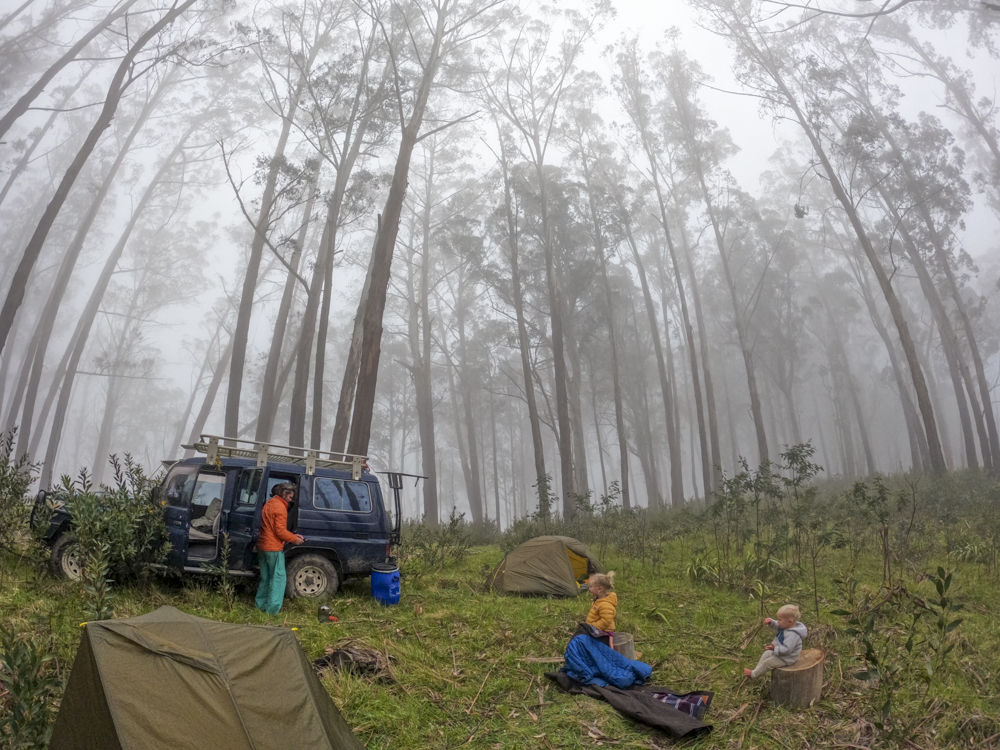
So, that’s exactly what we did. We added one more food drop, kept one that was already in place, and set off from Dead Horse Gap toward the finish line at the Tharwa Visitors Centre.
Over the next 250km, we averaged 10km a day. We pushed through gale-force winds, ice, and summer snowstorms, followed by days of extreme heat. We camped every night, carried all our own food, and at times, hauled multiple days’ worth of water.
It’s hard to know where to start with a journey this big, so I’ve broken it down into five bite-sized chunks. I’d love to hear from you, too—let me know in the comments below what else you’d like to know about the walk!
I’m starting here because the daily rhythm was what I enjoyed most. While the scenery and ecology shifted with every hill, our lives became beautifully predictable. With the long summer daylight, I never felt rushed. Mornings usually revolved around the first stream we hit, where I’d wash Kiah’s nappies and hang them on my pack to dry in the wind and sun as we walked.
Life was stripped back to a profound simplicity. The kids had two sets of clothes, but I only had one; I’d wash my hiking outfit on warm days and let it dry on my body while I walked. We found our pace by “bunny-hopping” each other; Pat followed Indigo’s natural flow while I matched Kiah’s rhythm. Indigo loved using the walkie-talkies to stay in touch, and our Garmin InReach kept Pat and I coordinated as we moved through the wilderness.
When he fell asleep in the front carrier, I’d keep a steady pace to ensure he stayed asleep, only stopping for lunch once he woke. We aimed for 10km a day—a distance that felt manageable. On the days where weather or terrain forced us to push to 14km, I truly felt the toll, but the 10km rhythm was our “sweet spot” that made the vastness of the AAWT feel achievable.
Honestly, Pat took care of the entire mental load for our nutrition—from the initial spreadsheets of planning to the physical packing of every food drop.
For Kiah and me, breakfast was usually a simple breakfast bar to get us moving. Our snacks consisted of a massive nut and seed mix that Pat actually mixed in a wheelbarrow! I went through about one bag a week, supplemented by a bag of dried fruit.
Lunch was typically wraps with dehydrated hummus. Pat took care of the cooking dinners every evening, (just as he does at home). We relied on dehydrated meals, often adding extra dehydrated vegetables.
People often ask if we got sick of dehydrated food. Honestly? Not at all. There was something incredibly liberating about not having to think, choose, or plan at the end of a long day. Most nights, we were eating by 5:30 or 6:00 PM, maintaining the same rhythm we have at home.
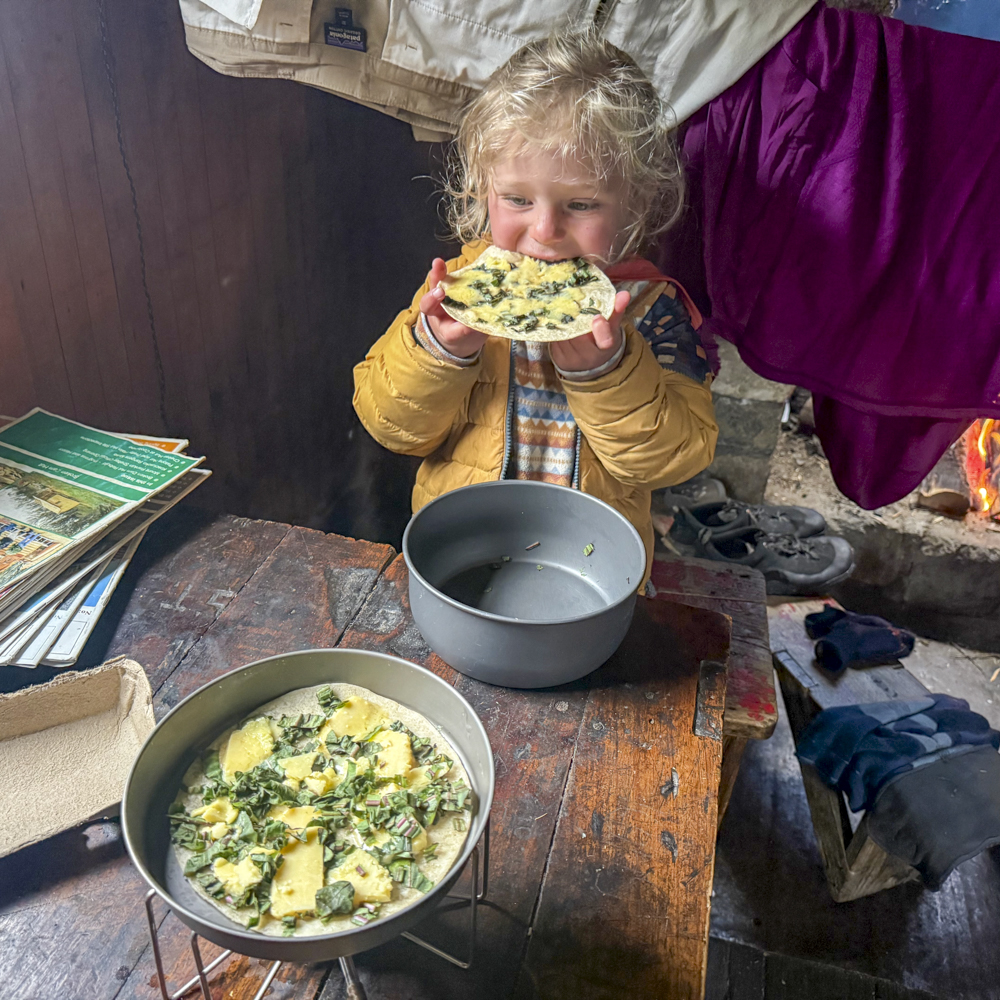
Pat also made sure to tuck some “luxury” treats into the food barrels for us. Highlights included Tilba cheese and even fresh eggs! If you ask Indigo what her favourite trail food was, she’ll tell you white chocolate almonds or “cheesy chapati pizza.”
As for me? Nothing will ever beat the amazing spaghetti bolognese we had inside the tent after a steep climb up from Guthega. Pat melted half a wheel of Tilba Camembert on top. Delicious.
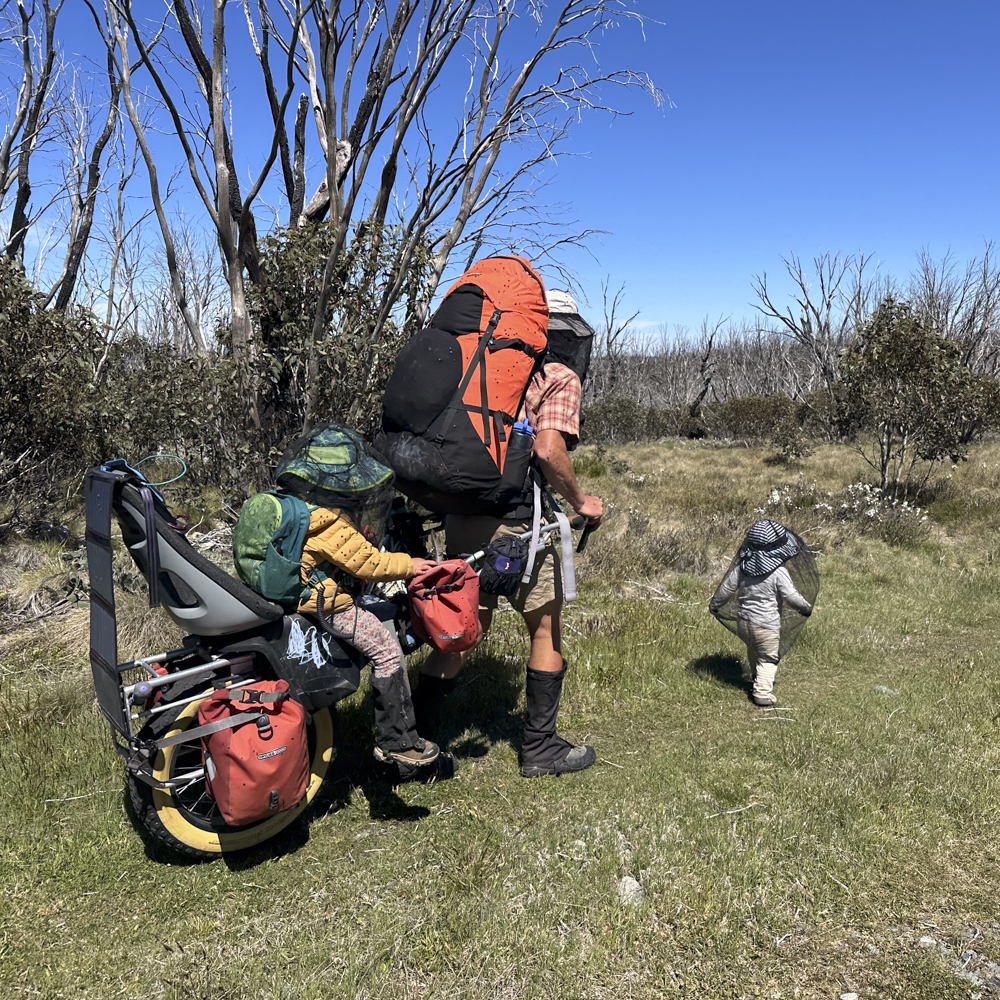
The cart was designed and built by Pat, so I almost feel like I shouldn’t be the one writing this! But since it’s the question we get asked most, I’ll share what I know. It was welded from aluminium, featured a braking system and attached directly to the waist strap of Pat’s backpack.
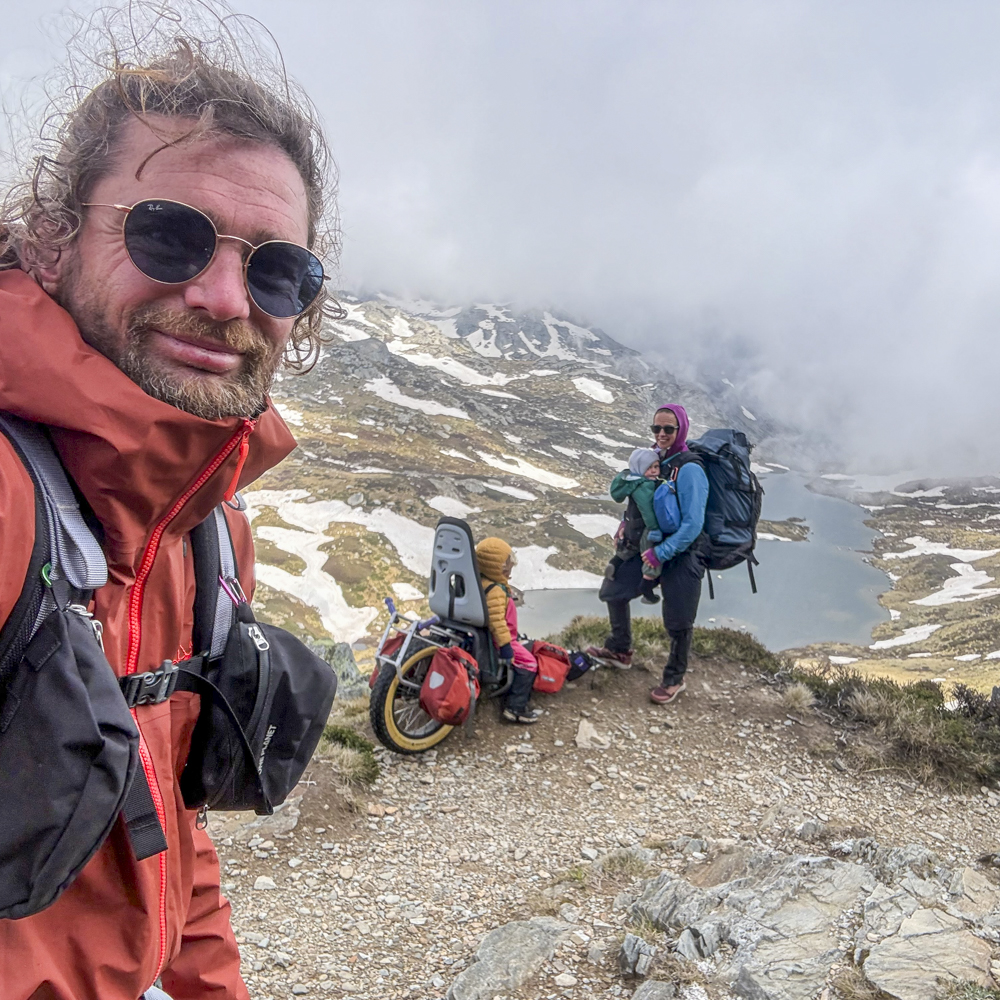
Bike panniers attached to the cart with light gear in it and indigo would sit comfortably on top on a padded seat while the heavy weight stayed on our backs. Indigo loved her ride, though she was a trooper and walked many of the hills. We even mounted a Thule bike seat for Kiah, but only used it on the rare flat sections! For the final week, Kiah mostly wanted to walk his own path, only hopping into the carrier for snake safety or when we needed to make time.
My backpack weighed between 25kg and 30kg, with Kiah adding another 12kg to my front. Pat’s pack was slightly lighter (20–25kg), mainly because my old canvas pack weighed 5kg before I even started packing it!
I started out with a standard child-carrier, but it couldn’t handle the total weight. It got so uncomfortable that I actually used Kiah’s nappy pads as makeshift shoulder and waist padding! Fixing that setup was a priority before we did the northern section.
For nappies, we stuck with our reusable, quick-dry microfibre system. To keep the workload down, Kiah was nappy-free as much as possible, wearing them only at night or while in the carrier.
Managing the washing was a daily ritual: we’d collect river water to clean them, then strap them to the back of our packs to dry in the wind and sun as we walked. If the sun was out at lunch, we’d lay them out on the rocks. On wet days, we got creative—drying them by the fire or even sleeping with them between my legs in my sleeping bag to let my body heat do the work!
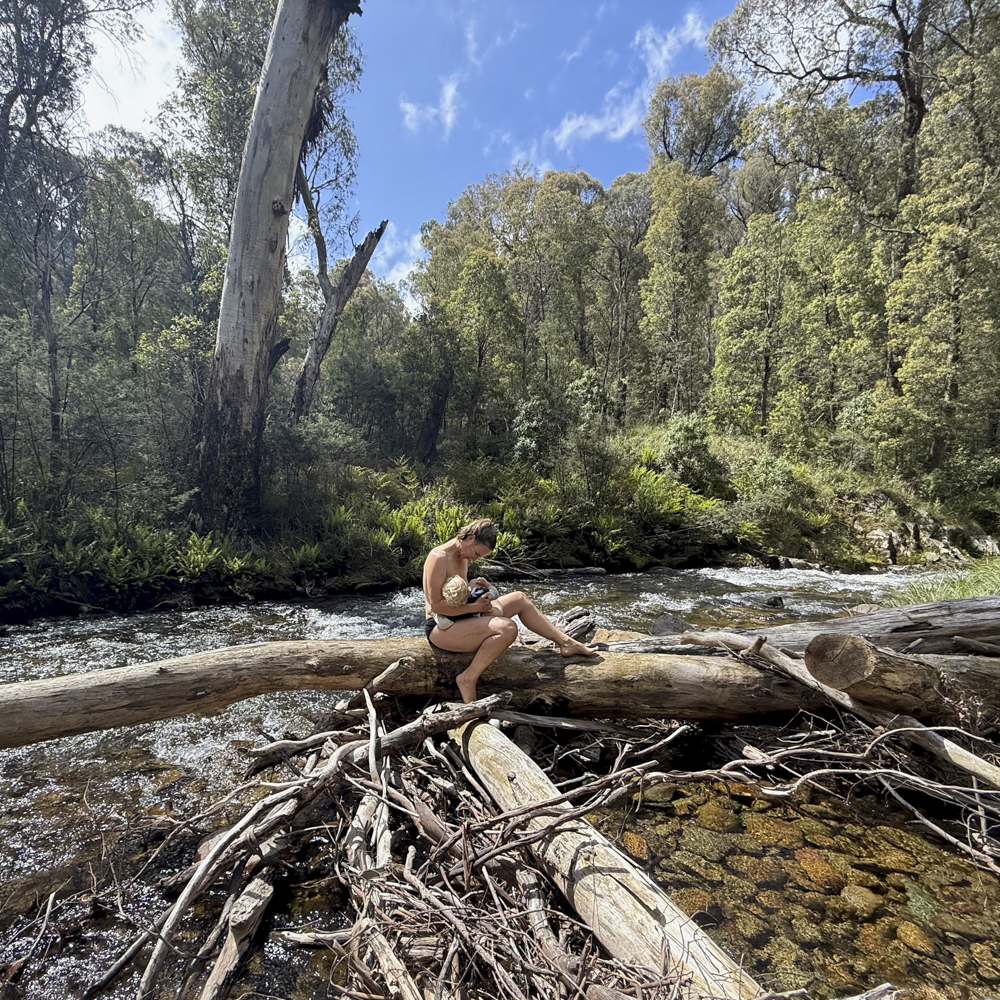
As for breastfeeding, it actually became a seamless part of our hiking rhythm. I’d offer Kiah milk whenever we stopped. If he was unsettled for a nap, I’d simply feed him to sleep while I kept moving.
Nighttime was surprisingly easy, too. I used a Sea to Summit air mattress, which was comfortable enough for side-lying feeding in the tent. When the weather turned—and we certainly had our share of snow and ice—I relied on button-up hiking shirts for easy feeding access. I’d just roll up my thermals and manage my layers to stay warm.
I could write a whole blog on gear, but these were the essential systems that kept us moving.
The Sleep System We used Mont Moondance 1-man tents. I shared mine with Kiah, while Pat and Indigo shared another. We slept on Sea to Summit air mattresses—the most comfortable mats I’ve ever used. As for sleeping bags, our Mont Brindabella sleeping bags were absolute life-savers. I initially thought they were overkill, but they kept us toasty through sub-zero nights. Kiah either tucked into my bag or wore a Macpac sleep suit, while Indigo had her own kids’ bag with armholes.
Clothing & Footwear: one pair of pants, one shirt, thermals, a down jacket, and rain gear. I lived in my Teva hiking boots, and when heat-induced blisters struck, I used a classic trail hack: two pairs of socks with a plastic bag in between to stop the friction. For the kids, high-quality down jackets, wooden thermals and waterproof layers were essential.
The Kitchen Our “kitchen” was just one stove and two pots that doubled as bowls.
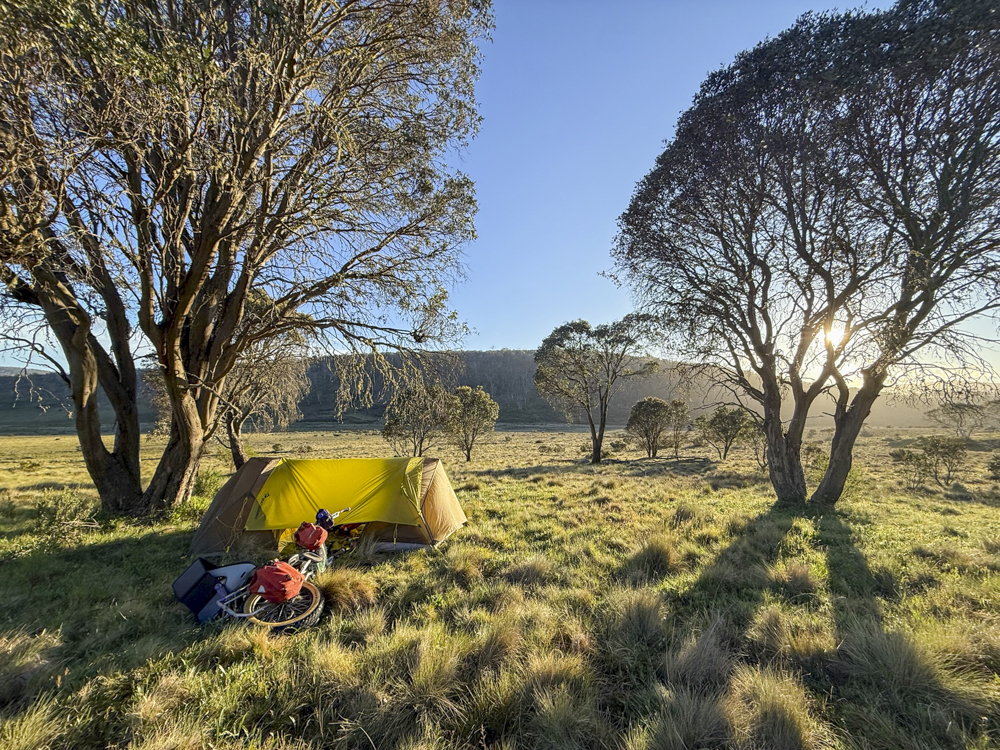
The biggest takeaway for me was that this was the first time in my adult life I was truly able to “switch off.” The mountains provided a bubble of presence that is so hard to find in our modern world.
Ironically, the day I finally “switched back on” was the day of the Bondi tragedy. I remember sitting on a rock and just crying. I wasn’t ready to return to civilisation; I wanted to stay in my bubble. I deleted my social media apps immediately, feeling that I just wasn’t ready for the “real world” yet.
To be honest, I’m still not entirely ready. While I love my life, it is hectic and busy. I’ve realised that everyday life at home is often far more stressful and demanding than life on the trail. Since returning, I’ve been finding ways to step away from my emails more frequently. I’m learning to let my team take over so I can have real time off—without the pressure of constantly checking and responding to guests. Fully trusting the Navigate Expeditions team has made this transition so much easier, and I don’t take their support for granted.
Ah, the “sixth” most asked question! While the AAWT was a massive undertaking, we aren’t slowing down—we’re just shifting gears into “shorter” adventures.
The kids and I recently did a fantastic three-night canoe trip in Kangaroo Valley with friends from the UK. I’m already planning another KV trip in June with family visiting from Germany, a Myall Lakes canoe expedition this winter, and some winter sailing.
Later this year, we’re heading to WA to tackle the Munda Biddi. Pat and I did this trail pre-kids, and we know it will be a brilliant 1000km off-road bike-packing trip with the little ones.
Watch this space! We’ll also be doing a full presentation about our AAWT walk at our “Evening of Adventure” event this July. Sign up to our e-newsletter to find out more about it—we’d love to see you there!
Want to hear more about their incredible journey in person? Come along to our Evening of Adventure on the 17th of July starting at 5:00 PM at Kangarutha Farm, Tathra, to see a special presentation by Jess and Pat as they share the highs, lows, and lessons from the trail.